Shinto — meaning "Way of the Divine" or "Way of the Gods" — is the indigenous religious tradition of Japan. It represents an almost entirely Japanese way of thinking, distilled from strong early influences including animism, nature veneration, ancestor worship, and, from the sixth century AD onward, Buddhism and Chinese cosmological thought. Unlike most world religions, Shinto has no founder, no single founding scripture, and no formal creed. It is, at its core, a lived relationship with the sacred forces — the kami — believed to animate the natural and human world.
The Concept of Kami
The word kami is often translated as "gods" or "spirits," but neither translation fully captures the concept. Kami are the sacred presences — forces, qualities, or essences — that dwell in and animate significant features of the world: mountains, rivers, waterfalls, trees, rocks, animals, and ancestors. Some kami are associated with natural phenomena of great power; others are revered forebears of particular clans or localities. The eighth-century chronicles Kojiki ("Record of Ancient Matters," 712 AD) and Nihon Shoki ("Chronicles of Japan," 720 AD) record the mythological accounts of the kami, including the creation of the Japanese islands by the primordial couple Izanagi and Izanami, and the birth of the sun goddess Amaterasu — from whom the imperial family was held to descend.
Types of Shinto
There are three broadly recognized forms of Shinto practice, all closely interrelated:
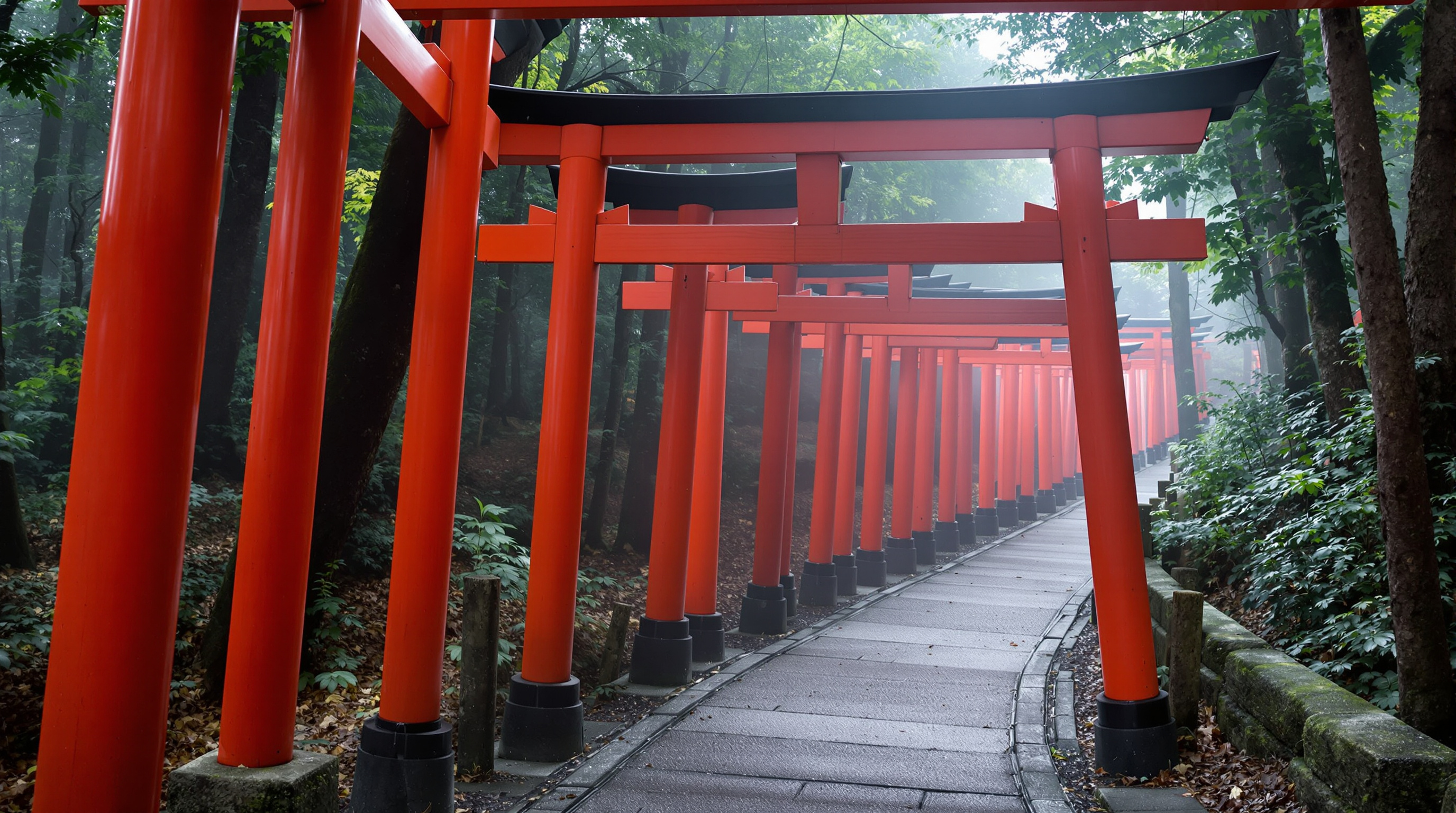
- Shrine Shinto (Jinja Shinto): The principal and most widespread form. Shrines (jinja) are the dwelling places of kami, typically located in natural settings — forests, mountains, near water — and marked by the distinctive gateway arch, the torii. Worship involves ritual purification, offerings, and prayer at the shrine. Japan has approximately 80,000 to 100,000 shrines, maintained by an estimated 20,000 priests.
- Folk Shinto (Minzoku Shinto): A loosely defined stratum of local customs, beliefs, and practices — including the veneration of small roadside images, household altars, and seasonal folk rituals — that underlies shrine practice in many communities.
- Sect Shinto (Kyoha Shinto): A collection of thirteen recognized independent Shinto denominations, many of which developed during the nineteenth century. These sects are distinguished by their specific founders, doctrines, or ritual emphases, and are formally organized as religious associations rather than shrine institutions.
Ritual and Practice
Shinto practice centers on maintaining a proper relationship with the kami through purification, offering, and prayer. The concept of harae (ritual purification) is fundamental: impurity (kegare), arising from death, disease, or moral transgression, must be cleansed before approaching the kami. Purification may take the form of ritual washing (misogi), ceremonial salt-scattering, or more elaborate priestly rites.
Shrine visits follow a recognized form: passing through the torii gateway (which marks the transition from the mundane to the sacred), rinsing hands and mouth at the temizuya (water basin), approaching the sanctuary, making an offering (typically coins), and offering a prayer. More elaborate ceremonies — matsuri (festivals) — are the heart of community Shinto life, involving processions, ritual music and dance (kagura), portable shrine (mikoshi) parades, and communal feasting. Matsuri mark the seasonal rhythms of the year and express the ongoing bond between the community and its protective kami.
Shinto and Buddhism
Buddhism arrived in Japan in the sixth century AD, and over the following centuries the two traditions became deeply intertwined in a phenomenon scholars call shinbutsu-shugo (the amalgamation of kami and buddhas). Kami came to be interpreted as manifestations of Buddhist bodhisattvas; shrines and Buddhist temples were often built side by side and administered together. This synthesis dominated Japanese religious life for over a millennium, until the Meiji government (1868 onward) forcibly separated the two traditions in its effort to promote State Shinto as a vehicle of national identity and imperial loyalty.
State Shinto — the government-directed, nationalist form of the tradition that prevailed from the 1860s until Japan's defeat in 1945 — was formally disestablished by the postwar constitution, which guaranteed religious freedom and separated religion from the state. Contemporary Shinto operates as a private religious tradition, though it remains deeply embedded in Japanese cultural identity and life-cycle customs.
Shinto's Moral Vision
Shinto in itself has no defining moral code comparable to the Ten Commandments or the Five Pillars of Islam. In the Shinto worldview, the world is fundamentally good, people are inherently good, and there is an underlying harmony in existence — a harmony ever threatened by pollution and evil spirits, which must be expelled through purification rites. This optimistic anthropology — the belief in natural human goodness — distinguishes Shinto markedly from traditions that emphasize original sin, moral corruption, or the fallen state of the world.
Shinto Today
Today Shinto remains a vital and largely Japanese tradition. The Association of Shinto Shrines (Jinja Honcho) oversees most of Japan's shrines. Many Japanese who would not describe themselves as devout Shinto believers nonetheless participate in shrine-related life-cycle and seasonal rituals — hatsumode (New Year shrine visits), shichi-go-san (a rite of passage for children aged 3, 5, and 7), and Shinto wedding ceremonies. The tradition's celebration of nature, community, and the sacred embedded in the everyday world continues to speak to millions.