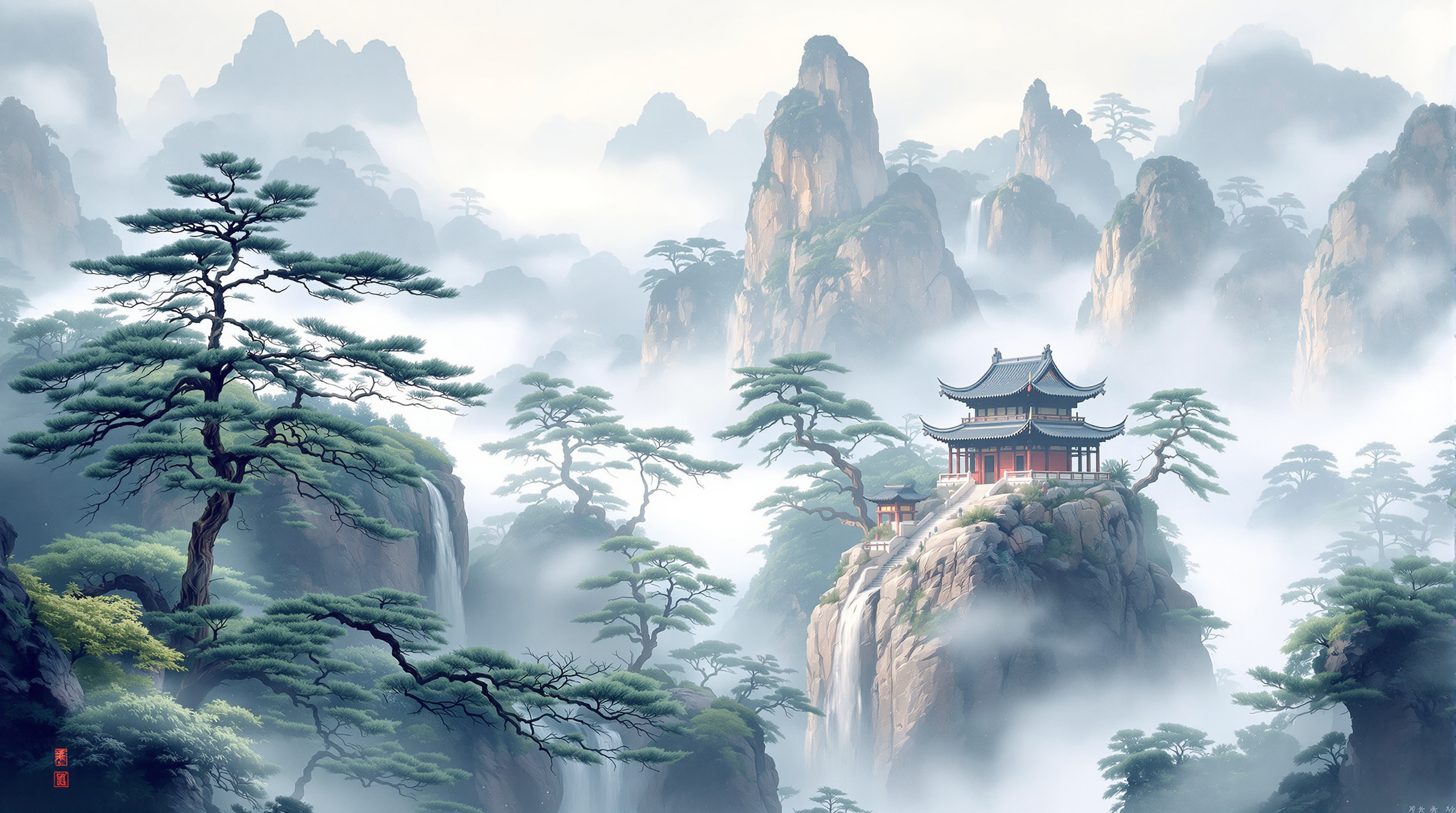
Taoism (also romanized as Daoism) is one of the oldest and most distinctive philosophical and religious traditions to emerge from China. Founded in prehistoric times and described by the philosopher Lao Zi — known in the West as Lao Tzu — who is believed to have lived around 600 BC, Taoism centers on the concept of the Tao, the Chinese word for "path" or "way." For Lao Tzu, the Tao referred not merely to a road traveled, but to the underlying principle of the universe itself: an ineffable, all-pervading force from which all things arise and to which all things return.
Origins and Historical Development
The historical origins of Taoism are deeply intertwined with the mythology, shamanism, and cosmological thought of early China. The tradition that coalesced around Lao Tzu's teachings drew on centuries of Chinese reflection on nature, harmony, and the proper ordering of human life. According to the historian Sima Qian, writing around 100 BC, Lao Tzu was a keeper of archives in the royal library of the Zhou court and lived during the sixth century BC in the state of Chu. When he observed the decline of the Zhou dynasty, legend holds that he departed westward on a water buffalo, and at the request of a gatekeeper, committed his wisdom to writing — producing the Tao Te Ching.
The Tao Te Ching ("The Classic of the Way and Its Virtue") consists of eighty-one short chapters of poetic prose, constituting one of the most translated and commented-upon texts in world literature. Despite the legendary simplicity of its composition, very little is known with certainty about its author. Scholars debate whether Lao Tzu was a single historical figure, a composite, or entirely legendary. What is beyond dispute is the profound influence the text has exercised over Chinese civilization and, later, global philosophical thought.
A second foundational figure in the Taoist tradition is Zhuangzi (Chuang Tzu), who lived in the fourth century BC. His collected writings — the Zhuangzi — expand on the Tao Te Ching's themes through parable, wit, and paradox, exploring the relativity of perspectives, the limits of human knowledge, and the freedom found in aligning oneself with the natural course of things.
Core Beliefs and Philosophy
At the heart of Taoism lies the conviction that the Tao cannot be fully named or defined. The opening lines of the Tao Te Ching declare: "The Tao that can be told is not the eternal Tao." This fundamental ineffability distinguishes Taoist metaphysics from most Western philosophical and theological systems. The Tao is not a personal deity but an impersonal, ever-present reality underlying all existence.
Several key concepts flow from this metaphysical core:
- Wu wei (non-action or effortless action): The ideal of acting in harmony with the natural flow of the Tao — not through passivity, but through action that is spontaneous, unforced, and without contrivance. A sage ruler, for instance, governs so lightly that the people hardly know he exists.
- Pu (simplicity, the "uncarved block"): The state of natural potential before it is shaped by desire, convention, or artifice. Taoism prizes return to this original simplicity.
- Yin and Yang: The complementary, interdependent forces — dark and light, receptive and active, feminine and masculine — whose interplay generates all phenomena. Taoism does not set these in opposition but sees them as phases of a single dynamic whole.
- Te (virtue or power): The particular expression of the Tao in each individual thing — the inherent nature or potency that enables a being to fulfill its proper function in the universe.
Religious Taoism and Practices
Alongside the philosophical tradition, a rich institutional religious Taoism (Dao jiao) developed, especially from the second century AD onward. Religious Taoism incorporates temples, priests, liturgy, ritual, divination, and a complex pantheon of deities, immortals, and spiritual beings. Movements such as the Way of the Celestial Masters (Tianshi Dao), founded in the late Han dynasty, organized Taoist communities under ordained clergy and established formal rites for healing, protection, and the maintenance of cosmic order.
Taoist practice encompasses a wide range of disciplines aimed at cultivating harmony with the Tao and promoting longevity or spiritual immortality:
- Meditation and inner alchemy (neidan): Visualization and breath-work techniques designed to circulate vital energy (qi) and refine the practitioner's inner nature.
- Physical cultivation: Practices including qigong and tai chi chuan, which employ slow movement and controlled breathing to harmonize body and mind with natural rhythms.
- Ritual: Elaborate ceremonies performed by ordained Taoist priests to communicate with the divine, expel negative forces, and restore cosmic balance in local communities.
- Dietary and herbal regimens: Historically important in Taoist cultivation for purifying the body and extending life.
Major Texts and Scriptures
The Taoist canon (Daozang), compiled and expanded over many centuries, contains over 1,400 texts encompassing philosophy, ritual, medicine, cosmology, and poetry. Its most central works remain the Tao Te Ching and the Zhuangzi, but also of great importance are the Liezi and numerous texts on inner cultivation, ritual procedures, and sacred geography.
Contemporary Presence
Today, Taoism is recognized as one of the five official religions of the People's Republic of China, with tens of millions of adherents and thousands of registered temples. Taoist thought has also spread globally, influencing New Age spirituality, environmental philosophy, psychology, and martial arts. The concepts of wu wei, yin-yang, and the Tao have entered popular culture far beyond their Chinese origins, attesting to the tradition's universal resonance.
For scholarly comparative purposes, Taoism stands as a remarkable counterpoint to the Abrahamic traditions: it posits no creator god, no original sin, no scripture handed down by divine revelation, and no mandate to proselytize. Its quiet insistence on harmony, naturalness, and the limits of human striving has enriched the global conversation about the nature of existence and the good life for more than two millennia.